Cuddy Composting Toilet: Quick Product Overview
Can an $850 waterless toilet provide genuinely low-maintenance sanitation in an RV, van, boat, tiny home, or off-grid cabin? The Cuddy Composting Toilet makes a credible case for buyers who want to avoid flushing water, black-tank infrastructure, and chemical additives, but it is not a maintenance-free appliance. Its value depends on whether reducing servicing matters enough to outweigh the premium over a basic portable toilet.
The Cuddy Composting Toilet is a self-contained unit with a 3.9-gallon solids chamber, a sealed liquids bottle, a 12V fan, carbon filter, manual mixer, LED emptying indicator, and optional external venting. The separation system is intended to keep liquid away from solids, while the fan and filter support odor management in enclosed spaces.
Listed as In Stock at $850, the Cuddy Composting Toilet is aimed at mobile and off-grid use rather than occasional festival or campsite use. You avoid water and chemicals, and you aren’t expected to add composting material every day, but you still need to empty, clean, and monitor the system. This review weighs that specialized convenience against the lower entry cost of simpler portable alternatives.

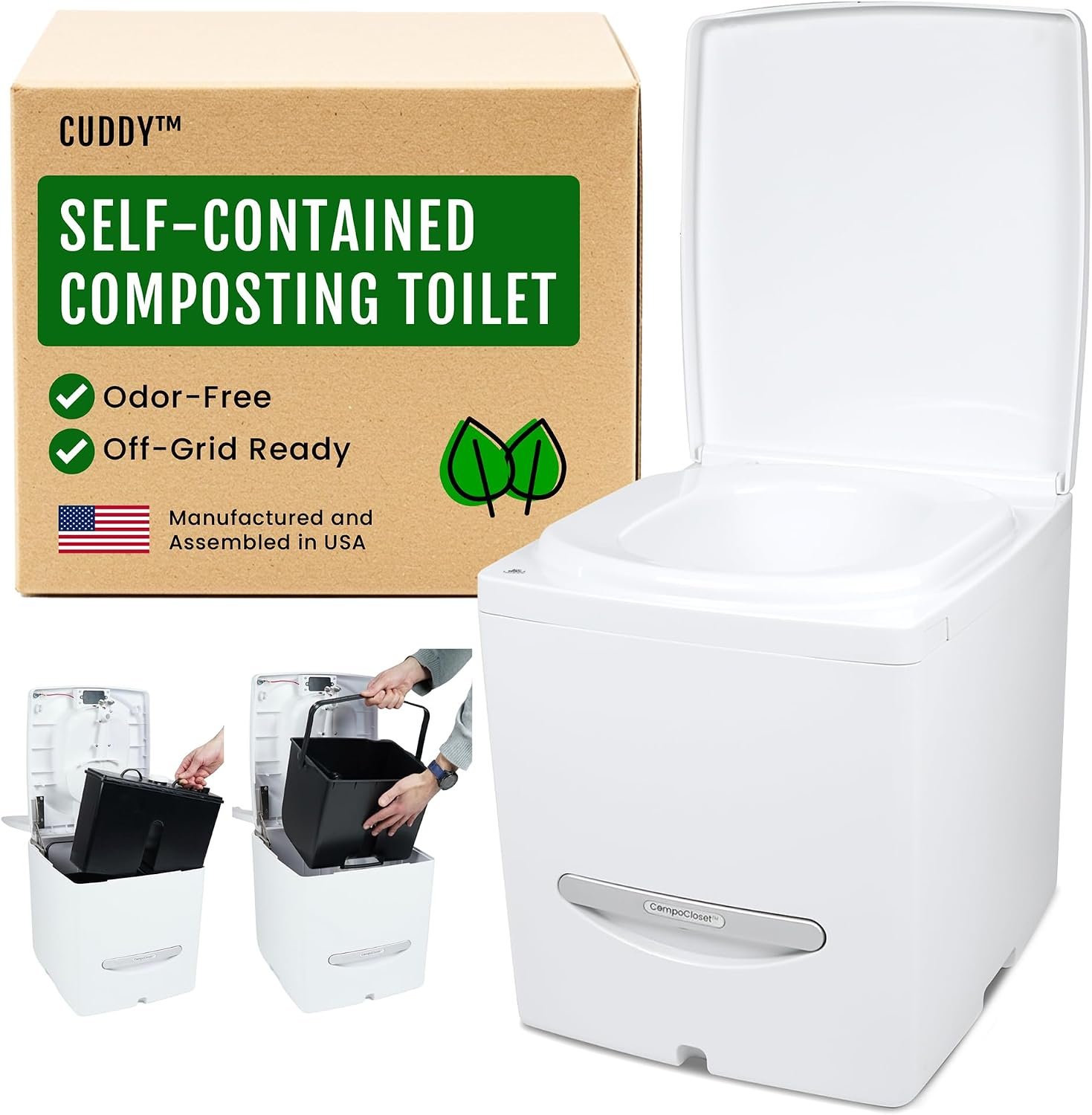
Cuddy Composting Toilet – Odorless, Waterless & Self-Contained for RVs, Vans, Boats, Tiny Homes & Off-Grid | 3.9 Gal, 12V Fan, Carbon Filter, No Chemicals, Easy Clean
$850
In Stock
How the Cuddy Composting Toilet Works
The Cuddy Composting Toilet uses a patent-pending two-plate drop-zone cover to direct liquids away from solids before they reach the main chamber. That separation is the foundation of the design: less liquid enters the solids area, while urine moves into a sealed container with a no-spill valve. Under typical use, the liquids container is expected to be emptied every few days, although occupancy and individual use patterns will change the interval.
After each visit, you turn the handle-operated manual mixer. This distributes material and helps maintain airflow without requiring you to open or disassemble the unit. The Cuddy Composting Toilet therefore replaces an automatic process with a short hands-on step; if several people use it, everyone needs to understand that routine.
A 12V fan moves air through the carbon filter to help control odors. The Cuddy Composting Toilet’s manufacturer describes an odor-control design, not a guarantee that every installation will be completely odor-free. Vent routing, temperature, cleaning, correct separation, and power availability can all affect results.
The toilet can continue operating when electricity is unavailable, but the fan will not provide powered airflow while disconnected. That may reduce odor-control performance, particularly in a small enclosed bathroom or during prolonged use without power.
Cuddy Composting Toilet Features in Detail
The main ownership benefit is the separation of capacity and disposal tasks. The 3.9-gallon solids chamber is intended to support extended off-grid use and fewer solids-disposal trips, but the actual interval depends on how many people use the toilet and how often. The removable solids bin is designed for contact-free handling through its bottom handle, with the product description giving an approximate emptying interval of every 2–3 weeks.
Liquid management is handled at the front. A sealed container, no-spill valve, and built-in LED alert are intended to make it clear when emptying is needed. The manufacturer’s stated liquid routine is approximately every few days, so you should plan disposal access that works even when the toilet is installed in a confined vehicle or cabin.
No water or composting chemicals are required. Compared with a conventional RV toilet, that can reduce freshwater use, flushing hardware, black-tank dependence, and chemical purchases. It doesn’t remove the need for cleaning or waste handling, but it simplifies the plumbing side of installation.
The included 12V cable suits many RV, van, boat, and cabin power systems. Check your available connection and cable route before installation. External venting is optional according to the product description; you may still prefer it in a very small enclosed bathroom or a space used continuously while stationary.
Installation, Power, and Cleaning Requirements
You can use the Cuddy Composting Toilet either flush-mounted or freestanding. Flush mounting gives a more permanent, integrated installation, while freestanding placement is easier to revise or remove. The practical choice depends on floor space, access to both waste containers, and how securely the unit must remain fixed during travel.
Use this installation sequence:
- Choose a stable location with enough clearance to remove the solids bin and reach the liquids container.
- Confirm that doors, aisles, and nearby fixtures don’t block emptying or cleaning.
- Route the included 12V cable safely, avoiding pinch points, heat, and moving parts.
- Test the fan before regular use.
- Secure the toilet appropriately for your vehicle or vessel, then check that it remains stable during movement.
The lightweight yet stable design is promoted for rough roads and choppy water, but your mounting and restraint requirements depend on the specific RV, van, boat, or cabin. Don’t assume freestanding placement is adequate in every moving installation.
Before the first use, add the recommended composting material once. After each visit, turn the mixer; monitor the LED; empty liquids every few days; and remove the solids bin according to occupancy. Clean the seat, bowl area, drop-zone cover, container exterior, valve area, and removable bin using manufacturer-compatible methods rather than unverified chemicals. The Cuddy Composting Toilet avoids water and chemicals, but it still needs routine cleaning, emptying, and power checks.

What Customers Are Saying About the Cuddy Composting Toilet
A reliable review synthesis requires a current star rating, total review count, and access to the newest written reviews. Those details were not included in the supplied product data, so it would be misleading to claim that buyers consistently praise odor control, bin removal, compact placement, or the manual mixer. The Cuddy Composting Toilet has manufacturer-stated features, but those are not the same as independently reported results.
For the same reason, there is no verified basis here for saying that repeated complaints concern installation fit, liquid-container capacity, fan noise, mixer operation, cleaning effort, travel stability, electrical setup, or confusing indicators. Isolated comments cannot be separated from recurring patterns without the actual review sample, and the available material does not identify whether reviewers used the product full-time, occasionally, in an RV, in a van, on a boat, or in a cabin.
When you check the listing in 2026, record the displayed rating and review total first, then read the newest written comments rather than relying only on the average score. Prioritize reviews that match your situation: number of occupants, climate, vehicle type, whether the fan runs continuously, and whether the unit is vented externally.
Review confidence is therefore limited for this assessment. The Cuddy Composting Toilet may perform as described, but the supplied information cannot confirm how closely customer experiences match the product description. Treat odor claims as design intentions until current, relevant buyer reports support them.
Who Should Buy the Cuddy Composting Toilet?
The Cuddy Composting Toilet is most suitable if you own an RV, van, boat, tiny home, cabin, or other off-grid property and want to avoid freshwater consumption, black-tank infrastructure, or chemical additives. Its 12V design aligns well with mobile electrical systems, while its ability to operate without electricity can be useful during outages or remote stays. You should understand, however, that unpowered operation may affect fan-assisted odor management.
The best-fit user is comfortable with a separated waste routine: keeping liquids and solids directed to their intended containers, turning the manual mixer after use, watching the fill indicator, and arranging periodic disposal. One person or a couple may find the intervals manageable; a family or household with frequent guests will fill the containers sooner. Capacity should guide your planning, not a promised number of days.
Choose caution if you want conventional flush-toilet behavior, cannot reach the containers for disposal, lack a safe 12V connection, or expect zero maintenance. The Cuddy Composting Toilet still requires handling and cleaning, even though it removes flushing and chemical steps.
Before ordering, measure the intended location, confirm door and aisle clearance, plan how each container will be removed, identify the 12V source, and decide whether external venting would help in your enclosed space. Those checks will tell you more about suitability than the product’s general off-grid positioning.
Cuddy Composting Toilet Compared With Alternatives
The Cuddy Composting Toilet sits between a basic portable toilet and larger, more established composting designs. The OGO NOMAD Portable Composting Toilet is a relevant comparison because it also targets RV, van, camping, and boat use with waterless waste handling. However, current capacity, controls, power details, customer rating, and price for that model were not supplied here, so you should verify those points on the live listing instead of treating an assumed specification as fact.
Nature’s Head Self Contained Composting Toilet is another established alternative. Its manual mixing approach and installation expectations may appeal to buyers already familiar with that design, while odor-management hardware and ownership routines should be compared using the current model specification. Separett Villa is a contrasting urine-separating model: its no-additives approach and installation or capacity priorities may suit a fixed property better, but it is not automatically a like-for-like mobile substitute.
| Product | Waste-handling method | Power or venting considerations | Maintenance routine | Capacity information | Price |
|---|---|---|---|---|---|
| Cuddy Composting Toilet | Separated liquids and solids; sealed liquids container | 12V fan and carbon filter; external venting optional | Manual mixing, liquid emptying, solids-bin emptying, cleaning | 3.9-gallon solids chamber | $850 |
| OGO NOMAD | Verify current listing | Verify current listing | Verify current listing | Verify current listing | Verify current listing |
| Nature’s Head | Verify current model details | Verify current model details | Manual mixing and regular emptying; verify details | Verify current listing | Verify current listing |
| Separett Villa | Urine separation; verify model details | Verify installation and venting requirements | Verify current routine | Verify current listing | Verify current listing |
The Cuddy Composting Toilet is the more informed choice when self-contained, waterless operation and the stated separation design fit your setup. A simpler cassette or bag-based portable toilet may be better value for occasional camping, while frequent off-grid use can justify composting equipment when water and dumping-station access are costly or inconvenient.

Is the Cuddy Composting Toilet Worth $850?
At $850, the Cuddy Composting Toilet is not a budget sanitation purchase. Its value comes from the costs and inconvenience it may help you avoid: flush water, black-tank infrastructure, dumping-station visits, chemical additives, plumbing, and some installation work. That equation is most favorable when you travel often or live where water and waste-service access are limited.
The Cuddy Composting Toilet’s stated 3.9-gallon solids capacity, approximately 2–3-week solids disposal interval, sealed liquid handling, and no-chemical operation could reduce the frequency of certain servicing tasks. That doesn’t establish a guaranteed financial payback, because your occupancy, disposal fees, cleaning routine, and installation costs will determine the real ownership cost.
Budget for more than the toilet itself. You may need composting material, cleaning supplies, mounting hardware, a suitable 12V connection, and preferred venting components. Even if external venting is optional, you may decide it is worthwhile for a tiny bathroom or a stationary installation.
Lower-cost portable toilets usually require some combination of bags, gels, cassette emptying, or more frequent servicing. They can make more sense if you camp only a few times a year. Choose the Cuddy Composting Toilet when waterless independence and reduced servicing are worth the premium; choose a basic portable model when occasional use and low upfront cost matter most.
Cuddy Composting Toilet: Final Buying Guidance
The Cuddy Composting Toilet is a $850 self-contained, waterless composting toilet designed for mobile and off-grid spaces. Its stated package includes a 3.9-gallon solids chamber, 12V fan, carbon filter, manual mixer, sealed liquids container, LED emptying indicator, no-spill valve, and optional external venting.
The Cuddy Composting Toilet is strongest for buyers who value low water use and self-contained waste handling. It is less suitable if you want zero maintenance, completely automatic operation, or the familiar behavior of a conventional flush toilet. The manufacturer’s odor-control design is promising, but the supplied data does not include a current customer rating or review count that would let you verify real-world consistency.
Complete these three checks before ordering:
- Confirm physical fit, movement clearance, and direct access for waste disposal.
- Plan the 12V connection and decide whether your installation would benefit from external venting.
- Make sure every user understands liquid-solid separation, mixer operation, monitoring, and cleaning.
The listing currently shows the product as In Stock, but price and availability can change, so verify both before purchase. Buy the Cuddy Composting Toilet when regular mobile or off-grid use makes its specialized sanitation design genuinely useful; skip it when a cheaper occasional-use portable toilet solves the problem adequately.
Pros and Cons
Pros
- Waterless, chemical-free operation reduces plumbing and consumable requirements.
- Separate waste handling, a sealed liquids container, and a no-spill valve are designed to simplify disposal.
- The 12V fan, carbon filter, manual mixer, LED alert, and flush-mounted or freestanding placement suit mobile and off-grid installations.
- The removable solids bin has a bottom handle intended to make disposal more hygienic.
Cons
- The $850 upfront price is high compared with basic portable or cassette toilets.
- Routine emptying, cleaning, mixer operation, and fill-level monitoring are still required.
- Best odor performance depends on correct separation, airflow, installation, and suitable 12V operation.
- The supplied product data does not include a current star rating, review total, or verified newest written-review sample.
Final Verdict
Key Takeaways
- The $850 unit is designed for regular RV, van, boat, tiny-home, and off-grid use rather than occasional camping.
- Its core design combines liquid-solid separation, a sealed liquids container, manual mixing, a 12V fan, and carbon filtration.
- You still need to manage emptying, cleaning, mixer operation, and power planning.
- No current star rating, review count, or newest written-review sample was supplied, so customer sentiment should be verified before purchase.
- The deciding question is whether reduced water use and servicing justify the premium over a basic portable toilet.
Frequently Asked Questions
What are the drawbacks of a composting toilet?
The main drawbacks are that you still need to empty the liquids container and solids bin, clean the bowl area, operate the mixer, and plan a suitable installation. It also costs more upfront than a basic portable or cassette toilet and may need dependable 12V power for best odor management.
What is the best off-grid composting toilet?
The best choice depends on your space, occupancy, installation, power supply, and waste-disposal arrangements. The Cuddy is a strong option for mobile and off-grid users who want a self-contained, waterless design, while established alternatives may suit buyers who prefer different mixing or ventilation arrangements.
What if you have diarrhea in a composting toilet?
Diarrhea can add extra liquid to the solids chamber and may make odor control and cleaning more demanding. Use the mixer as directed, monitor the liquids container more closely, clean affected surfaces promptly with manufacturer-compatible methods, and follow local waste-disposal requirements.
What do you do with toilet paper when using a composting toilet?
Follow the product’s waste-handling guidance and local disposal rules. Some users place toilet paper in the solids chamber, while others use a separate covered container to reduce filling and simplify emptying; the better choice depends on the toilet’s instructions and your disposal routine.