Nature's Head composting toilet: product overview
Can a $1015 waterless toilet replace conventional plumbing in a cabin, tiny home, ADU, workshop, or other off-grid structure? The Nature’s Head composting toilet makes a persuasive case when excavation, septic installation, water lines, or black-tank hardware would cost far more than the toilet itself. It is not the cheapest way to handle occasional camping, but it is designed for owners who want a permanent self-contained system.
This is a complete Structure Kit rather than merely a standalone toilet. The package includes the toilet, a 110V AC adapter, a shell vent with installation kit, and a free 9L bag of coco coir. At the listed price, the kit is in stock, although price and availability should be treated as a snapshot rather than a permanent promise.
The Nature’s Head composting toilet separates urine and solids inside one self-contained unit. A low-draw ventilation fan supports airflow and odor management, while the waterless design avoids plumbing, septic systems, black tanks, and chemical treatments. You still have to empty and monitor the waste containers, but you avoid much of the infrastructure associated with a conventional flush toilet.
For 2026, the strongest fit is an owner who values long-term off-grid independence over the lowest purchase price. The Nature’s Head composting toilet is worth considering if your building has a sensible vent route, dependable power for the fan, and a practical plan for handling separated waste.

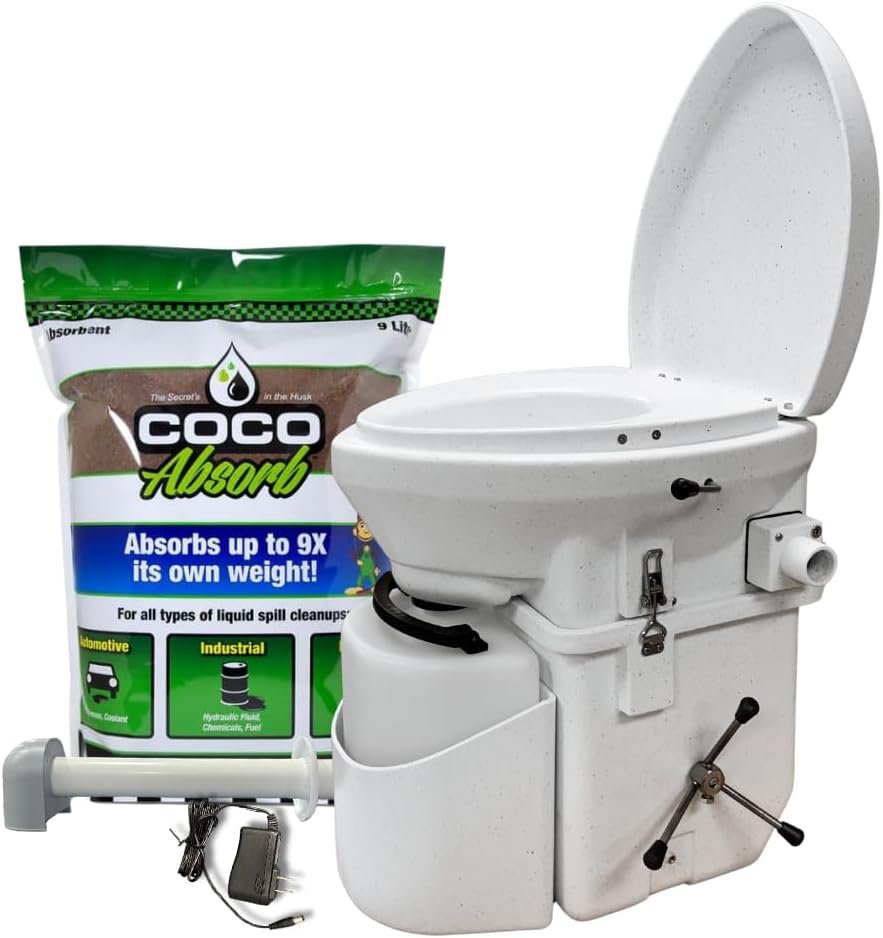
Nature's Head® Structure Kit with Composting Toilet – Complete All-Inclusive Kit – 100% Self-Contained Waterless Toilet System for Cabins, Tiny Homes & Off-Grid Living – Spider Handle
$1015
In stock
What comes with the Nature's Head composting toilet kit
The kit’s main advantage is that it bundles several parts you would otherwise need to source separately. The toilet unit provides the separating and solids-handling hardware; the 110V AC adapter supplies the listed electrical connection; the shell vent and installation kit provide the core components for routing airflow outside; and the 9L coco coir bag gives you starter medium for the solids chamber.
That combination is more convenient than ordering a toilet first and then discovering that vent parts, power equipment, or starting medium are missing. The Nature’s Head composting toilet is therefore better viewed as a structure-installation package, not a grab-and-go portable toilet. Before ordering, confirm that the included parts match your building and that no additional fittings are required for your planned wall or roof exit.
The product description claims marine-grade construction, which fits the intended use in cabins, tiny homes, workshops, ADUs, homesteads, and off-grid buildings. It suggests a body designed for demanding environments, but construction durability should still be separated from assumptions about every internal component or future replacement part.
The supplied data confirms a 110V AC adapter but does not confirm alternate voltage options, battery compatibility, fan wattage, or solar wiring. In the full manual or seller listing, verify these details before publication or purchase:
- External dimensions, seat height, and total weight
- Mounting hardware and floor-fixing requirements
- Vent-tube length, fittings, and weather protection
- Warranty coverage and replacement-part availability
The Nature’s Head composting toilet package is unusually convenient when those requirements fit your project. It is less convenient if you need a battery-only installation or have to redesign the vent system around unconfirmed specifications.
Nature's Head composting toilet capacity and daily operation
Capacity is one of the key reasons to consider this system. The listed solids capacity is approximately 60–80 uses, and the manufacturer says the solids bin typically lasts up to one month for two users. That is a useful estimate for extended stays, but it is not a guaranteed calendar interval: occupancy, diet, moisture, and correct separation can all change the result.
The more frequent task is the 2.2-gallon urine tank. Typical emptying is every 2–3 days, depending on use. This distinction matters because a buyer may read “one month” and imagine the entire toilet can be ignored for four weeks. The Nature’s Head composting toilet reduces plumbing work, but it does not remove the need for regular liquid handling.
The spider-handle agitator is intended for close-quarters bathrooms. It mixes the solids medium without requiring the larger side clearance that a more extended control arrangement could need. During normal use, follow this sequence:
- Use the toilet while keeping liquids directed into the front separator.
- Check that the solids chamber has an appropriate amount of coco coir or other approved medium.
- Turn the agitator regularly according to the current instructions.
- Monitor the urine level and empty the tank before it becomes overfull.
Because the Nature’s Head composting toilet is waterless, it needs no water connection, septic system, black tank, or chemical treatment. However, waterless does not mean maintenance-free. Separation, moisture control, agitation, and emptying determine whether the system remains pleasant to use.
Installation requirements for cabins, tiny homes, and ADUs
Installing the system should be simpler than connecting a conventional toilet to sewer or septic, but it is not completely tool-free. You still need a stable floor location, a route for the vent, suitable electrical access, and enough room to remove the urine tank and service the solids chamber. The Nature’s Head composting toilet works best when these decisions are made before walls and cabinetry are finished.
A practical installation sequence is:
- Choose a stable floor position and identify how the user will reach the service areas.
- Allow access for urine-tank removal and solids-bin servicing.
- Route the vent through the structure using the supplied shell vent kit.
- Connect the 110V adapter at the planned electrical point.
- Test airflow before regular use and confirm that the vent path is unobstructed.
Vent routing matters because airflow helps control odor and moisture. In a small, tightly sealed bathroom, a poorly planned exit or blocked path can make the system less comfortable even when the toilet itself is operating correctly. Exact clearance measurements and vent specifications are not included in the supplied product data, so take them from the current installation manual rather than guessing.
Before buying the Nature’s Head composting toilet, confirm the available electrical supply, wall or roof exit point, vent clearance, floor strength, and service access. Ask the installer:
- Where will the urine bottle be emptied?
- Can the solids chamber be removed without dismantling the toilet?
- Is the fan powered continuously?
- Is the vent protected from rain and snow?
Those answers will tell you more about installation difficulty than the phrase “easy installation” on a product listing.

Odor control, ventilation, and maintenance
The ventilation fan is central to the system’s odor strategy. Continuous low-draw airflow moves air through the unit to support odor management and the composting process, but it cannot compensate for poor waste separation. If liquid enters the solids chamber or the vent is blocked, the fan is being asked to solve the wrong problem.
Plan for a simple maintenance rhythm. Inspect or empty the 2.2-gallon urine tank roughly every 2–3 days, while the solids chamber may last up to one month for two users under typical conditions. Your actual schedule will depend on occupancy and use, so level checks are more reliable than following a calendar blindly.
With the Nature’s Head composting toilet, prevention is easier than troubleshooting. Keep urine directed into the separator, avoid overfilling the solids chamber, maintain coco coir at a suitable texture, and ensure the fan remains powered and unobstructed. Excess moisture, poor separation, and compacted medium are more likely to create trouble than the waterless concept itself.
Separate three jobs when planning care: routine surface cleaning, urine-tank care, and solids-bin emptying. The supplied information does not establish a chemical formula or sanitation schedule, so use the current manual for approved cleaners and procedures rather than improvising harsh chemicals.
Waterless operation removes plumbing-related maintenance such as flush-valve repairs and sewer clogs, but it does not eliminate odors, splashes, liquid buildup, cleaning, or blockages caused by incorrect use. If odors rise, check liquid separation first. If airflow stops, check fan operation and then inspect the vent path before assuming the unit has failed.
These checks make the Nature’s Head composting toilet more predictable in daily use: confirm separation, confirm airflow, inspect levels, and service each container before it is full.
What customers are saying about Nature's Head composting toilets
The supplied product data does not include a verified Amazon star rating or review count at publication time, so it would be misleading to invent either figure. A trustworthy buyer should record the live rating and total review count separately when checking the listing, then read detailed reviews rather than relying on the headline score alone.
Customer reviews indicate that the most useful themes to investigate are odor performance with correct venting, installation difficulty, the durability of the marine-grade body, seated comfort in compact spaces, urine-tank emptying frequency, and the usefulness of the spider handle. These are practical questions, whereas broad statements that the toilet is “great” reveal little about how it performs in a two-person cabin or a busy tiny home.
Verified buyers report different experiences when installation contexts vary. A detailed review that identifies household size, vent length, power arrangement, and months of use is more valuable than a short review posted immediately after delivery. The listed 60–80 solid-use capacity and one-month estimate should be compared with those household reports, not treated as a universal result.
Look for recurring complaints about difficult vent routing, liquid-bottle management, replacement parts, cleaning, electrical setup, or expectations that the unit can operate with no user maintenance. Also check whether buyers consider the $1015 price justified by the included adapter, vent kit, starter coco coir, construction, and avoided infrastructure.
The Nature’s Head composting toilet deserves closer scrutiny when reviews disagree. Compare recent comments with older ones, separate installation problems from product failures, and treat isolated extreme experiences cautiously. The Nature’s Head composting toilet may suit one off-grid building very well and another poorly if the vent route or service plan differs. The Nature’s Head composting toilet should therefore be judged through the context of each review, not through a single star number.
How the spider-handle design affects compact bathrooms
The spider handle is the close-quarters agitator configuration. It is intended for smaller bathrooms where a larger external crank or foot-operated mechanism could be awkward, particularly in tiny homes, cabins, workshops, and other structures where each inch of usable space affects the layout.
When evaluating the Nature’s Head composting toilet, focus on the actual interaction rather than assuming the handle is automatically better. Can you reach it comfortably from the seated position? Does it turn smoothly? Will a wall, cabinet, shower panel, or adjacent fixture interfere with its movement?
The spider-handle version should be compared with Nature’s Head’s foot-spider model by control placement, not by declaring one universally superior. A foot control may suit a layout where hands-free agitation is convenient, while the spider handle may make more sense when side access is limited. Neither choice removes the need to plan service access and ventilation.
Before installation, sketch the toilet, vent route, service access, and door swing on the floor. Add the planned cabinetry and wall thicknesses, then check that the handle remains usable when the room is complete. Do not rely on an assumed footprint or side-clearance figure unless it is confirmed in the current listing or manual.

Nature's Head composting toilet compared with alternatives
The Nature’s Head composting toilet Structure Kit is primarily a permanent-installation product. Its supplied 110V adapter, shell vent, installation kit, and starter coco coir make it a natural candidate for a cabin, tiny home, ADU, or workshop where you want a dedicated ventilated system. The OGO NOMAD Portable Composting Toilet is a different proposition: its name and positioning point toward portable use in vehicles, camping, boats, and mobile applications. Confirm its current capacity, ventilation method, power requirements, and included accessories before making a direct specification comparison.
Separett Villa takes another approach to urine separation and solids handling. Buyers should compare its installation context, composting or collection method, cleaning routine, and whether a separate solids-management plan is needed. It may suit a household that prefers its particular separation system, but its requirements should be checked against your building rather than assumed to match this kit.
The Cuddy Composting Toilet is another alternative for shoppers seeking a modern compact format. Check its current price, capacity, fan design, power source, carbon-filter arrangement, warranty, and included accessories at publication time. Product names alone do not establish equal ownership costs.
Portable chemical or bag-based toilets generally cost less initially, but they do not provide the same permanent ventilated, urine-separating setup or extended solids capacity. To compare fairly with the Nature’s Head composting toilet, record:
- Total purchase price and everything included
- Vent and power requirements
- Urine and solids emptying frequency
- Service access and replacement consumables
- Warranty terms and whether the toilet will be moved regularly
The Nature’s Head composting toilet is strongest when infrastructure avoidance matters more than portability. A mobile user may reasonably prefer the OGO NOMAD, while a household with a different solids-collection preference may favor Separett Villa.
Who should buy this off-grid toilet system?
The strongest buyers are owners of cabins, tiny homes, workshops, ADUs, homesteads, and other off-grid buildings who want to avoid sewer, septic, black-tank, or water connections. The system can be especially practical where water is limited, occupancy is seasonal, excavation is difficult, or conventional waste infrastructure would be disproportionately expensive.
Household size is a central part of the decision. Two users may achieve up to roughly one month between solids-bin servicing under typical conditions, but urine emptying remains a task roughly every 2–3 days. That combination suits an owner who can perform small, frequent checks and occasional larger servicing rather than someone expecting the toilet to be unattended.
Choose another format if you need a fully portable toilet, lack a practical vent route or continuous power source, are unwilling to handle separated waste, or expect zero maintenance. The Nature’s Head composting toilet is also not automatically suitable for every emergency, rental, RV, or boat scenario; local rules, mobility, ventilation, and installation constraints may change the answer.
Use this decision sequence:
- Determine whether the structure can support the required venting.
- Confirm electrical access for the supplied adapter and continuous fan operation.
- Estimate daily users and likely occupancy patterns.
- Plan exactly where separated urine and solids will be handled.
- Compare the complete installed cost with septic, sewer, and other composting toilets.
If those checks work in your favor, the Nature’s Head composting toilet offers a sensible route to long-term independence. If any one of them fails, a portable or differently ventilated design may create fewer compromises.
Is the $1015 Nature's Head kit good value?
At the listed $1015 price, the value depends on what you would otherwise spend making the building functional. The package includes the toilet, 110V AC adapter, shell vent with installation kit, and a free 9L coco coir starter bag. That is a more useful comparison than the price of a bare toilet because essential installation components are already part of the stated bundle.
The Nature’s Head composting toilet can justify a higher upfront cost when it avoids plumbing, septic excavation, black-tank hardware, water use, and chemical purchases. However, there is no responsible way to claim a specific payback period without knowing local labor, excavation, permitting, materials, and utility costs. Calculate those figures for your own structure instead.
Allow for ongoing ownership expenses as well. You may need additional coco coir or another approved medium, electricity for continuous ventilation, cleaning supplies, replacement bottles or seals, and eventually fan or vent components. These costs are usually smaller than a new septic installation, but they should still appear in your budget.
Compare competing products only after confirming their current prices and included accessories. A cheaper toilet may require separate venting, power equipment, mounting parts, or consumables, which can narrow the apparent price gap. The Nature’s Head composting toilet is strongest value for a permanent off-grid installation that can use the included vent and adapter; it is less compelling for occasional camping or anyone focused only on the lowest initial price.
The listed status is in stock at the time of this review, but both stock and the $1015 price can change. Treat them as checked listing information, then calculate the complete installed cost before committing.
Pros and Cons
Pros
- Complete kit includes the toilet, 110V AC adapter, shell vent with installation kit, and a free 9L bag of coco coir.
- Waterless, self-contained operation avoids water lines, septic infrastructure, black tanks, and chemical treatments.
- Approximately 60–80 solid uses and a solids-bin expectation of up to one month for two users can suit extended off-grid stays.
- Spider-handle configuration is designed for compact bathrooms where a larger external control could be awkward.
- Marine-grade construction is intended for cabins, tiny homes, workshops, ADUs, homesteads, and other demanding settings.
Cons
- The $1015 upfront price is high compared with basic portable or bag-based toilets.
- The 2.2-gallon urine tank may need emptying every 2–3 days in typical use.
- Installation still requires a suitable vent route, electrical access, floor support, and service clearance.
- The supplied product data does not confirm exact dimensions, fan wattage, battery compatibility, warranty terms, or alternate-voltage support.
- It is not maintenance-free: waste separation, ventilation, cleaning, and emptying remain the user’s responsibility.
Final Verdict
Key Takeaways
- The $1015 Structure Kit includes the toilet, 110V AC adapter, shell vent and installation kit, plus a 9L coco coir starter bag.
- Its waterless design avoids plumbing, septic, black tanks, and chemicals, but regular waste separation and maintenance are still required.
- The solids chamber is listed at approximately 60–80 uses, while the 2.2-gallon urine tank typically needs emptying every 2–3 days.
- Spider-handle operation is aimed at compact bathrooms, but you should plan venting, service access, power, and handle clearance before installation.
- It is best suited to permanent off-grid buildings rather than buyers seeking portability or the lowest upfront price.
Frequently Asked Questions
What are the drawbacks of a composting toilet?
The main drawbacks are regular urine-tank emptying, the need for correct liquid-and-solid separation, continuous ventilation, and installation planning. It also costs more upfront than a basic portable or bag-based toilet and still requires cleaning and waste handling.
What is the best off-grid composting toilet?
The best choice depends on your structure, power supply, vent route, occupancy, and waste-handling preferences. The Nature’s Head Structure Kit is a strong option for permanent cabins, tiny homes, workshops, and other off-grid buildings because it includes the toilet, vent kit, adapter, and starter medium.
What if you have diarrhea in a composting toilet?
Diarrhea can add excess moisture and may make odor control and composting more difficult. Use the toilet carefully, monitor the solids chamber, maintain ventilation, and follow the current manufacturer instructions for cleaning and waste handling.
What do you do with toilet paper when using a composting toilet?
Follow the manufacturer’s instructions for whether toilet paper can go into the solids chamber and how much is appropriate. If your manual recommends keeping excess paper out, place it in a suitable covered waste bin instead; avoid adding more material than the chamber can manage.