Monterey Thistledown Weed Killer: Quick Product Overview
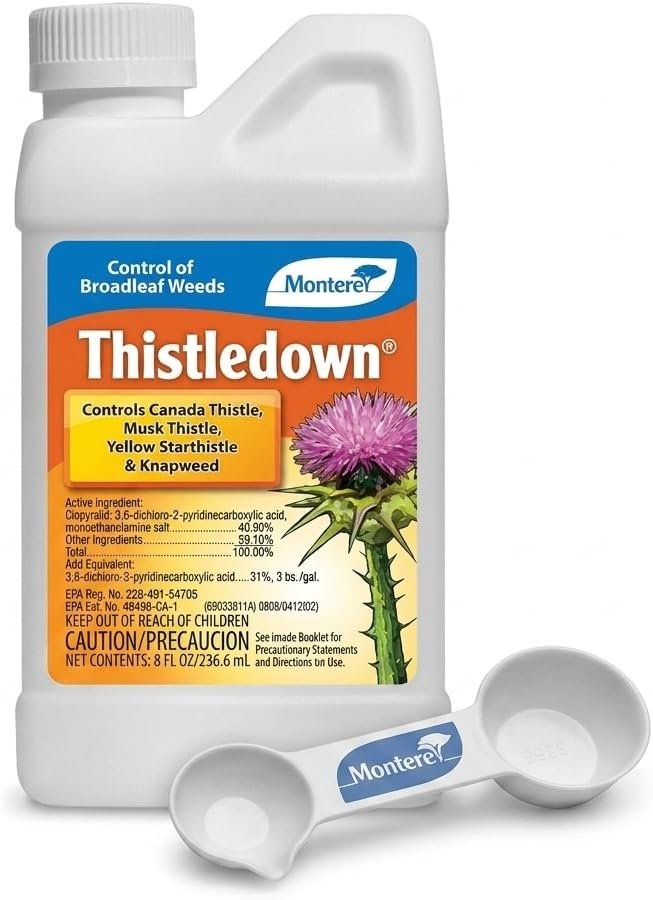
When thistles are spreading through pasture or range, a general lawn weed killer may be the wrong tool. Monterey Thistledown Weed Killer is a concentrated, selective herbicide aimed at actively growing broadleaf weeds in approved pasture, range, ranchette-pasture, and other non-crop settings. The listed product is Monterey Thistledown Weed Killer Concentrate, oz, priced at $40.98 and shown as In Stock.

This is a post-emergent treatment, so it is intended for weeds that are already growing rather than dormant plants or broad, unrestricted vegetation clearing. Its likely targets include Canada thistle, musk thistle, star thistle, knapweed, kudzu, dandelion, and Oxalis. That makes it potentially useful for a narrow weed-control problem, but not for a vegetable garden, ornamental bed, or every unwanted plant on a property.
The central buying question is whether you need selective broadleaf control on an approved non-crop site. Most vegetables and ornamentals are susceptible, and the product must not be applied to ditches containing irrigation water. This review examines the clopyralid formula, target weeds, pasture restrictions, handling requirements, customer-feedback evidence, alternatives, and value for shoppers.
This image is property of Amazon.com.

What the Clopyralid Formula Is Designed to Do
Monterey Thistledown Weed Killer uses clopyralid as its stated active ingredient. It is described as a selective, post-emergent herbicide for actively growing broadleaf weeds. “Selective” does not mean harmless to every plant except the weed: it means the formula is aimed at a particular group of plants, while susceptible desirable species can also be injured or killed.
Actively growing weeds are the intended target because the treatment needs a responsive plant to absorb and move the herbicide. Dormant, drought-stressed, damaged, or incorrectly identified plants may not respond as expected. The supplied product information does not provide independent kill-rate measurements, guaranteed treatment speed, or a universal success percentage, so you should avoid assuming that every application will produce the same result.
Because this is a concentrate, you must mix it according to the current label; never apply the bottle contents directly. Before mixing, identify the weed, confirm that your property is an approved use site, read the complete label, and follow its specified dilution and application directions. Monterey Thistledown Weed Killer is best approached as a label-directed agricultural or non-crop treatment, not as an improvised household spray.
Monterey Thistledown Weed Killer Target Weeds and Expected Coverage
The clearest target group for Monterey Thistledown Weed Killer is thistles and knapweed. The product description specifically names Canada thistle, musk thistle, star thistle, and knapweed. It also lists kudzu, dandelion, and Oxalis, although control can depend on label directions, the plant’s growth stage, weather, and site conditions.
Do not read “broadleaf weed control” as grass control. A product directed at broadleaf weeds is not automatically intended to eliminate unwanted grasses, and treating mixed vegetation without identifying it can damage plants you want to keep. Before treatment, compare the weed’s leaves, flowers, stems, and growth habit with a reliable local identification resource. This is especially important when clover, alfalfa, forage plants, ornamentals, or young desirable seedlings grow nearby.
A practical approach is to photograph the area before spraying and mark the treatment boundary. Then check the treated plants after the interval specified by the label rather than immediately repeating the application. The available information does not establish supported percentages, days-to-results, or reapplication intervals. For that reason, Monterey Thistledown Weed Killer should be judged by correct identification and label-compliant use, not by an assumed schedule or guaranteed result.
Where Thistledown Can and Cannot Be Used
Monterey Thistledown Weed Killer is described for ranges, pastures, ranchette pastures, and other non-crop areas. That site approval is the main reason to consider it, but it does not make the product suitable for every part of a rural property. The description says to avoid ornamentals and vegetables because most vegetable plants and ornamental plants are susceptible.
There is also a specific restriction against applying Thistledown on ditches containing irrigation water. Drift, runoff, overspray, and contaminated equipment can move herbicide beyond the intended patch. A spray that lands on a nearby garden, ornamental border, drainage channel, or irrigation ditch may create a problem even if the original target weed was appropriate.
Before application, map nearby gardens and ornamental plants, identify drainage and irrigation channels, confirm that the treatment area is non-crop, and follow the label’s directions for keeping people and animals away. Remember that a pasture may be an approved use site while individual plants inside it remain vulnerable. Monterey Thistledown Weed Killer can injure or kill legumes in treated pastures, so site approval is only the first part of the safety check.
This image is property of Amazon.com.

Pasture Use, Grazing, and Legume Restrictions
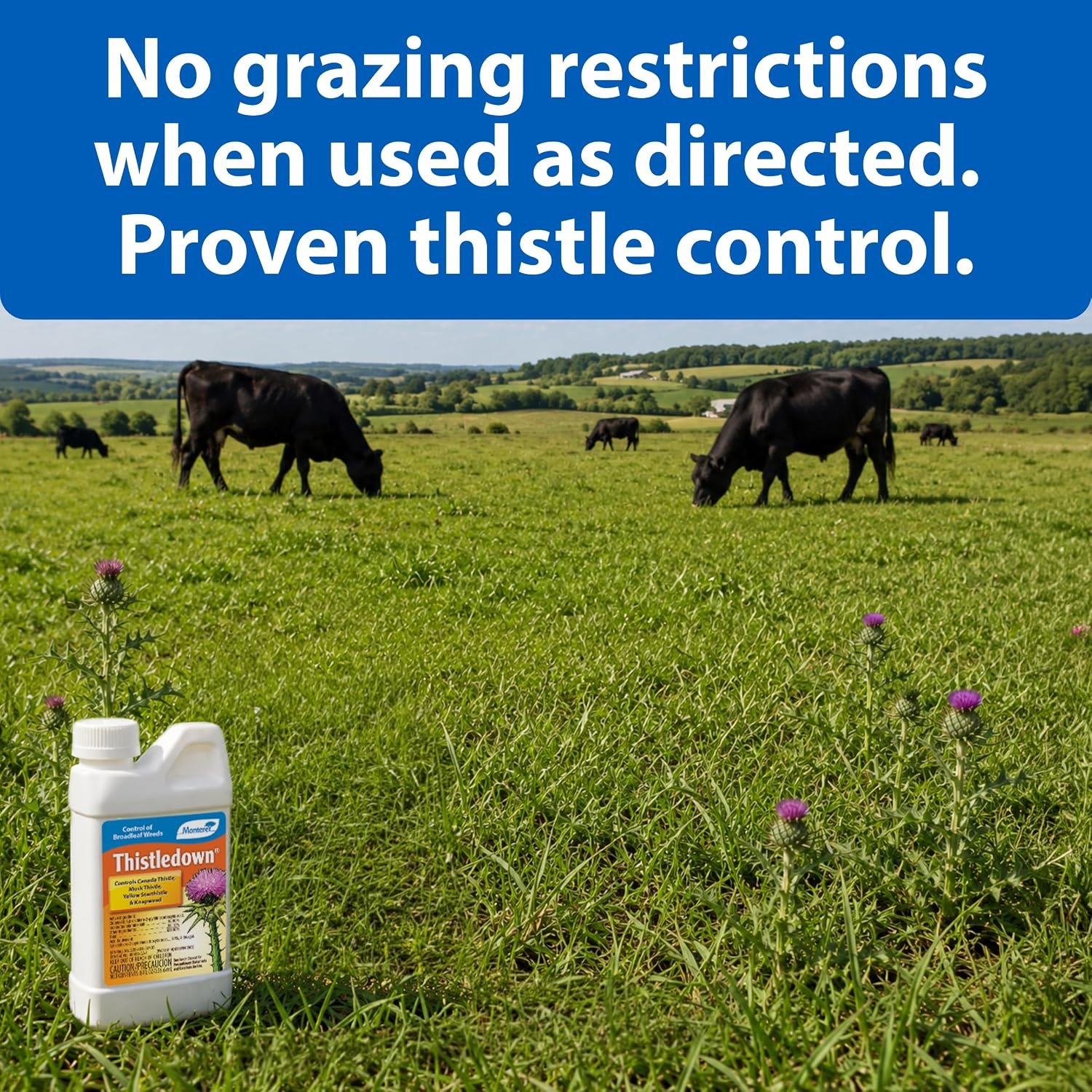
The product description states that Monterey Thistledown Weed Killer has no grazing restrictions when used on ranges, pastures, ranchette pastures, and non-crop areas. That statement should not be confused with a claim that the spray is harmless to livestock, wildlife, soil, or water. Handling, application, exposure, and environmental requirements remain controlled by the current product label.
The more significant pasture limitation is plant safety: legumes in treated pastures will be injured or killed. Walk the full area before spraying and look for clover, alfalfa, peas, beans, and other legume species. If desirable forage is mixed with the target weeds, consider fencing off sensitive sections or treating only clearly separated weed patches rather than broadcasting across the entire pasture.
Keep the label with your pasture records and document the treatment date, location, mixing rate, weather conditions, and weed species treated. Those notes make later management decisions more informed and help you avoid repeating an unsuitable application. Even with no stated grazing restriction, Monterey Thistledown Weed Killer should be used only after you have considered the forage plants and followed every current label requirement.
How to Handle and Apply the Concentrate Responsibly
Use Monterey Thistledown Weed Killer through a label-compliance process rather than by estimating a stronger mixture. First identify the weed and confirm the site. Next calculate the required product amount, use the specified mixing procedure, and apply only to actively growing target weeds in the approved area.
- Read the complete current label before opening the concentrate.
- Check wind, nearby gardens, ornamentals, drainage, and irrigation channels.
- Measure and mix only the amount and water volume specified for your use.
- Wear protective clothing and equipment selected according to the label, avoiding contact with clothing or skin.
- Clean equipment, handle empty containers, wash exposed clothing, and store the product as directed.
Do not improvise a stronger solution, combine products, or apply outside the listed crop and site directions. Exact rates, weather limits, re-entry directions, water volumes, and disposal rules are not supplied here and should not be invented. The same caution applies after spraying: follow the label’s cleanup sequence and secure the remaining concentrate away from unauthorized users, children, and animals. Responsible use is a condition of evaluating Monterey Thistledown Weed Killer, not an optional extra.
What Customers Are Saying About Monterey Thistledown
The supplied listing information does not include a current star rating, review total, or verified-purchase statistic for Monterey Thistledown Weed Killer. It would therefore be misleading to claim that buyers generally praise its speed, mixing, bottle coverage, or pasture performance. Customer reviews should be checked on the live listing at publication or checkout, with particular attention to whether comments describe the same weed and an approved use site.
When reviewing the available buyer feedback, separate reports about visible results from explanations involving incorrect weed identification, dormant growth, unsuitable locations, poor timing, or label deviations. Comments about Canada thistle, musk thistle, star thistle, knapweed, kudzu, dandelion, and Oxalis are more relevant than reviews about unrelated lawn weeds. Also look closely for mentions of legumes, grazing, irrigation ditches, drift, ornamental damage, or vegetable injury.
An oz concentrate may be economical for spot treatment, but it may be insufficient for extensive acreage depending on the label rate and application method. Individual reviews are anecdotes, not proof of universal performance. Until a live review count and recurring patterns are verified, the most defensible assessment is that Monterey Thistledown Weed Killer has a clearly defined use case but unconfirmed customer-consensus evidence in the supplied data.
This image is property of Amazon.com.

Monterey Thistledown Weed Killer Compared With Alternatives
Compare Monterey Thistledown Weed Killer with Crossbow Herbicide by starting with the label rather than the brand name. Check each product’s active ingredients, intended weeds, approved use sites, selectivity, pasture directions, and susceptible plants. A product aimed at brush, woody plants, or a different weed spectrum may not be an appropriate substitute for a clopyralid product directed at listed thistles and broadleaf weeds.
Southern Ag 2,4-D Amine Herbicide is another named alternative, but its active ingredient, crop restrictions, pasture directions, and vulnerable plants can differ substantially. A competing herbicide is not automatically safer, stronger, or better suited to your property. The correct match depends on the target weed, property type, grazing plan, desirable forage, nearby water, and whether you need spot treatment or wider coverage.
Use this comparison order: target weed, site approval, desirable plants at risk, mixing requirements, container size, current price, and credible customer results. Compare price per treated area only after confirming each label’s rate, because shelf price alone cannot establish value. Monterey Thistledown Weed Killer should win consideration only when its specific label fit is clearer than the alternatives for your actual site.
Who Should Buy This Concentrated Thistle Killer?
The best fit for Monterey Thistledown Weed Killer is a property owner managing actively growing thistles or other listed broadleaf weeds on an approved pasture, range, ranchette pasture, or non-crop site. You may prefer this type of selective treatment when you need to address broadleaf weeds without choosing a general vegetation killer. The product’s stated target list gives you a useful starting point, provided you identify the weed correctly.
It is a poor fit for vegetable gardeners, ornamental landscapers, and people treating irrigation ditches. It is also unsuitable when you cannot separate target weeds from sensitive plants, particularly legumes. The oz bottle may make more sense for targeted or limited treatment than for a large infestation, but actual practicality depends on the label’s mixing and coverage directions rather than container size alone.
- Identify the weed.
- Confirm the property is an approved site.
- Check for legumes, gardens, ornamentals, drainage, and irrigation water.
- Review current label restrictions.
- Compare the required amount with the $40.98 purchase price.
Do not select Monterey Thistledown Weed Killer solely because it is labeled for pasture or because no grazing restriction is stated; the plants within that pasture still determine whether treatment is sensible.
Is the $40.98 Price Good Value?
At the listed $40.98, Monterey Thistledown Weed Killer is priced as a specialized oz concentrate rather than an inexpensive, unrestricted household weed spray. The concentrated format may be useful because you mix it according to the label for the approved application, but the small container also makes the label rate and expected coverage central to the value calculation.
For a defined patch of listed thistles in pasture or range, the price could be reasonable if the mixture covers the area you need and protects the surrounding grass better than a less suitable product. For broad acreage, value is harder to judge without the label’s application rate and coverage directions. A low bottle price from an alternative does not prove a lower cost per treated area; you must compare active ingredient, container size, use site, rate, and intended coverage.
The supplied listing shows the product as In Stock, but you should confirm the live price and availability before checkout. The weakest value case is an ornamental, vegetable, or general lawn application where the restrictions make the product unsuitable regardless of price. For shoppers, Monterey Thistledown Weed Killer is potentially fair value for targeted, label-approved thistle control—not a bargain for unrestricted weed removal.
This image is property of Amazon.com.
What to Check Before Ordering Thistledown
Before ordering Monterey Thistledown Weed Killer, identify the weed using a reliable local resource and confirm that the current label permits treatment on your property. Inspect nearby plants, drainage, and irrigation channels, then decide whether you need spot treatment or acreage-level control. This sequence prevents the common mistake of buying a pasture herbicide for a garden or ornamental problem.
- Confirm the exact package contents: Monterey Thistledown Weed Killer Concentrate, oz.
- Check the live listing’s seller information, price, stock status, label images, and updated safety directions.
- Review whether your target weed and site appear in the current directions.
- Make sure you have suitable measuring and application equipment, protective clothing, secure storage, and time for proper cleanup.
Also consider whether sensitive forage, legumes, vegetables, ornamentals, or irrigation water could be exposed. If you cannot control drift or clearly separate the target area, choose a different management approach. In short, Monterey Thistledown Weed Killer is a specialized option for listed broadleaf weeds in approved pasture and non-crop settings, not an all-purpose garden weed killer.
Pros and Cons
Pros
- Selective, post-emergent formula based on clopyralid
- Specifically lists several troublesome thistles and other broadleaf weeds
- Stated for ranges, pastures, ranchette pastures, and non-crop areas
- Product description states no grazing restrictions for listed pasture and range uses
- Concentrated oz format may suit targeted spot treatment
Cons
- Most vegetable plants and ornamentals are susceptible
- Legumes in treated pastures may be injured or killed
- Must not be applied to ditches containing irrigation water
- Not intended as a general lawn, vegetable-garden, ornamental, or grass-control product
- The supplied data provides no current rating, review count, coverage figure, or independent performance measurements
- The $40.98 price may be difficult to justify for large acreage without confirmed label coverage
Final Verdict
Key Takeaways
- This is a clopyralid-based, post-emergent selective herbicide for listed broadleaf weeds in approved pasture, range, ranchette-pasture, and non-crop settings.
- The named targets include Canada thistle, musk thistle, star thistle, knapweed, kudzu, dandelion, and Oxalis, but it is not a general grass or garden weed killer.
- Most vegetables and ornamentals are susceptible, and legumes in treated pastures may be injured or killed.
- The $40.98 price may make sense for targeted treatment, but value depends on the label rate, coverage, site approval, and size of the infestation.
- The supplied data does not include a current rating or review count, so customer consensus cannot be responsibly claimed.
Frequently Asked Questions
What is the best thing to kill roots?
The best root-control method depends on whether you are dealing with invasive plants, tree roots, or roots blocking a drain. For plants, removing the plant and as much root as practical is often more predictable than applying an herbicide, while drain problems may require mechanical clearing or a product specifically labeled for that use. Monterey Thistledown is described for actively growing broadleaf weeds, not as a general root killer.
What is the most effective root killer for plants?
There is no single root killer that is safest and most effective for every plant. You should identify the species, select a product whose label specifically permits that use, and consider whether desirable nearby plants could be damaged. The clopyralid-based product reviewed here targets listed broadleaf weeds and should not be treated as a universal root-killing product.
Does Root Kill really work?
Root-killing products can work when the product, target plant, application method, and site all match the label. Results vary with plant species, growth stage, weather, and whether the roots are connected to a living plant. Thistledown’s supplied description supports broadleaf weed control in approved settings, but it does not provide evidence that it treats every type of root problem.
How quickly does root killer work?
The timing varies by active ingredient, plant species, growth stage, and application conditions. You should use the product label’s stated evaluation or reapplication guidance rather than repeating an application immediately after spraying. The supplied information for Monterey Thistledown does not provide a verified number of days to results.